
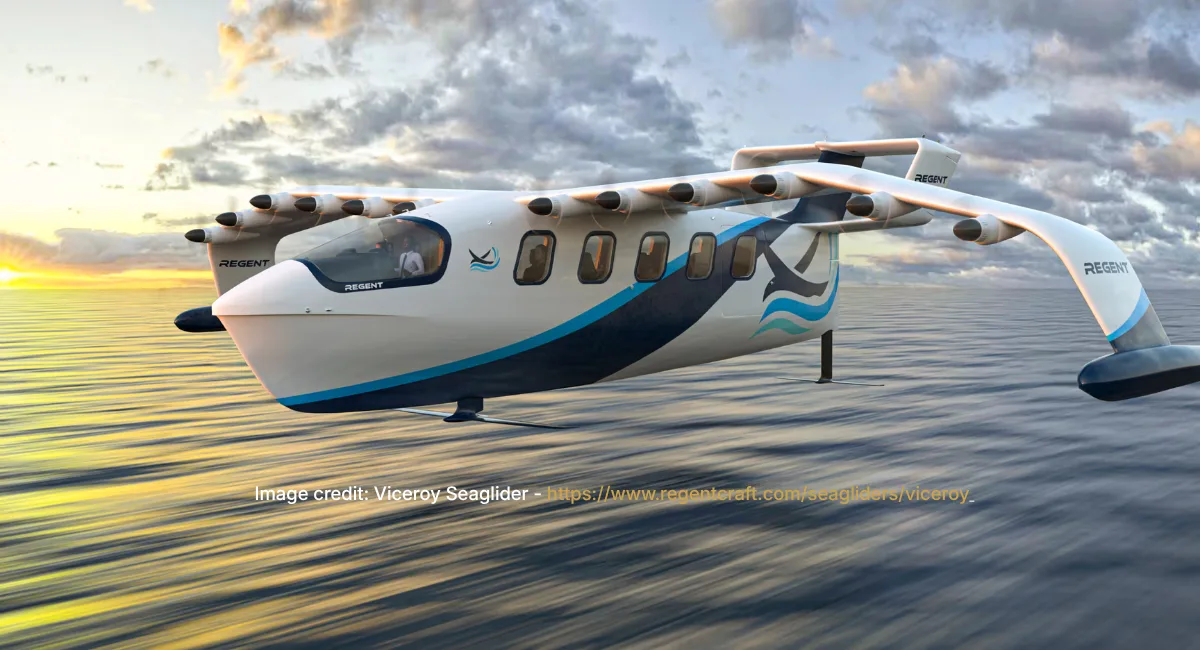
I saw a video this week of an all-electric aircraft skimming a few meters above Narragansett Bay at 180 miles an hour, and my first thought was not about the vehicle. It was about everything that had to happen before that vehicle was ever allowed near real water with people inside it.
The craft is the Viceroy Seaglider, built by REGENT Craft, a Rhode Island company reinventing short-distance coastal travel. Once I looked into how it actually gets built and tested, I realized it was a near-perfect illustration of something I think about daily in my own research.
A vehicle inspired by how birds actually fly
The Viceroy takes its core idea from a trick birds have used for millions of years. Pelicans and other seabirds glide low over open water using ground effect, the cushion of denser air that forms when a wing flies close to a surface beneath it. That cushion reduces drag dramatically, letting the bird cover long distances while barely flapping.
REGENT built an entire vehicle class around that same physics, classified as a wing-in-ground-effect craft. It genuinely blurs the line between an aircraft and a boat, and it is regulated as a marine vessel rather than an airplane.
Float, foil, fly: the three modes that make it work
The Viceroy operates in three distinct modes, and understanding the sequence matters, because each one solves a different problem.
At the dock, the vehicle floats on its hull like an ordinary boat, and passengers board exactly as they would for any ferry. As it moves away from shore and picks up speed, it rises onto hydrofoils, which lifts the hull clear of the water and gives the craft wave tolerance and tight manoeuvrability through harbor traffic and coastal chop. Once it reaches open water, it lifts fully into ground effect flight, cruising within roughly one wingspan of the surface at speeds up to 180 miles per hour, on battery power alone, for a range of about 180 miles.
That transition sequence, hull to foil to flight, is the entire engineering challenge in miniature. Get the handoff between modes wrong and the vehicle is unstable or unsafe. Get it right and you have something that behaves like a boat in a harbor and an aircraft in open water.
Testing an aircraft before it ever touches water
Here is the part that pulled me in as an engineer rather than as someone just admiring a cool machine.
MathWorks, whose MATLAB and Simulink tools REGENT relies on for its flight control stack, describes how the company used Model-Based Design across the vehicle’s development, from early flight control software through the certification process. In practice, that means engineers built a detailed virtual model of the craft itself, alongside a modeled representation of the operating environment: wave states, wind conditions, transition dynamics between modes, and edge cases that would be dangerous or simply impractical to test physically on the first attempt.
That combination, a model of the vehicle plus a model of the environment it operates in, is what a digital twin actually is. Not a fancy 3D render. A working virtual replica precise enough that testing it teaches you something true about how the real thing will behave.
Why the importance of digital twins goes far beyond one aircraft
This is where I want to make the general case, because the importance of digital twins is not really about seagliders specifically. It shows up anywhere physical testing is expensive, dangerous, or simply too slow to iterate on quickly.
A digital twin lets you run scenarios that would be irresponsible to attempt physically first. What happens if the transition from foil to flight happens in an unexpected wave state? What happens at the edge of the battery’s operating range? You can run those cases a thousand times in simulation before you ever risk a physical prototype or a person on board.
It also changes the economics of engineering entirely. Every hour spent on physical testing costs materials, personnel, safety infrastructure, and time. Catching a design flaw in simulation costs almost nothing by comparison. The importance of digital twins, in practice, is that they let you fail cheaply and repeatedly in a virtual space so you fail rarely, if at all, in the physical one.
Where this connects to my own research
I am currently completing my Master’s thesis at the University of Rostock on large-scale data collection for fingerprinting-based indoor localization systems, and the parallel to REGENT’s approach is direct, even though the domain could not look more different.
Fingerprinting-based localization works by building a database that maps radio signal signatures to physical locations inside a building. That database has to be built by physically walking through the space and recording measurements, which is already slow. It becomes genuinely difficult in a highly dynamic environment like a hospital, where equipment carts, mobile scanners, and other radio-reflecting objects are constantly changing position, subtly altering the radio environment from one hour to the next.
Building that database purely through physical measurement in an environment that will not hold still is close to impractical at real scale. A digital twin of the radio environment, one that models the space computationally and can be updated as conditions change, is what makes large-scale data collection tractable at all. It is the same underlying idea REGENT used to test an aircraft before it ever touched water, applied instead to mapping how radio waves behave inside a hospital corridor.
Seeing the same principle validated in something as visually dramatic as a flying boat is, honestly, a nice reminder that the work I am doing sits inside a much bigger and increasingly important engineering discipline.
Genuine respect to the team at REGENT Craft and to co-founder and CEO Billy Thalheimer for the ambition behind this project, and to MathWorks for building the tooling that makes this kind of virtual-first engineering development possible at this level of rigor.
If you want to see the craft in action, MathWorks’ original post is linked below, along with the sources behind the technical details in this article.
Sources
- REGENT Craft, “The future of maritime mobility takes flight: REGENT announces world’s first human-crewed Seaglider flight,” 2026, regentcraft.com
- gCaptain, “REGENT Seaglider Takes First Crewed Flight in Major Step Toward Commercial Service,” 2026
- Maritime Executive, “Regent’s Prototype Seaglider Completes First Human-Crewed Flight,” 2026
- CompositesWorld, “REGENT Completes First Crewed Flight of Composites-Intensive Viceroy Seaglider,” 2026
- Axios, “Regent Craft’s electric sea glider gets closer to reality,” 2026
- MathWorks, Certification Standards and Aerospace and Defense solution pages, mathworks.com
